Posted July 15, 2008
Tumor-inhibiting protein discovered by Temple researchers could be effective in the treatment of leukemia
Angiocidin also shown to stimulate the body’s immune system
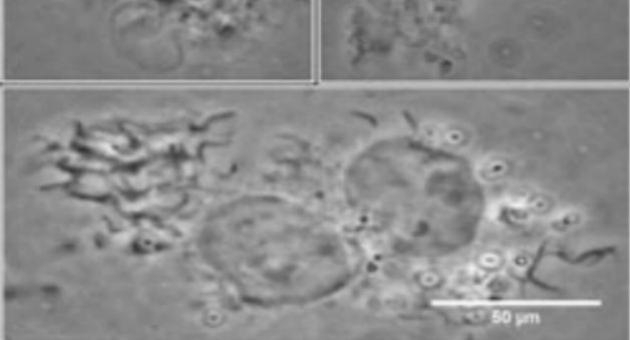
Photo courtesy George Tuszynski
The tumor-inhibiting novel protein Angiocidin induces a differentiation of monocytic leukemia cells into a more normal macrophage-like phenotype, allowing them to be more easily treated by chemotherapy.
Angiocidin, a tumor-inhibiting novel protein discovered by Temple University researchers, may also have a role as a new therapeutic application in treating leukemia, according to a study by the researchers.
The study, “The Novel Angiogenic Inhibitor, Angiocidin, Induces Differentiation of Monocytes to Macropahges,” will be published in the July 15 issue of the journal Cancer Research. The research was done by Temple biology doctoral student Anita Gaurnier-Hausser under the direction of George Tuszynski, a professor of neuroscience in Temple’s School of Medicine and a professor of biology in Temple’s College of Science and Technology.
“Angiocidin is a protein that has a lot of anti-cancer activity and inhibits angiogenesis, a physiological process involving the growth of new blood vessels from pre-existing vessels, which is a fundamental step in the transition of tumors from a dormant state to a malignant state,” said Tuszynski, who discovered the protein.
Tuszynski said that over the years, the researchers had looked at the protein’s effect on solid tumors like breast cancer, prostate cancer and colon cancer.
“All of these cancers are inhibited by Angiocidin by virtue of the fact that this protein inhibits vascularization or the formation of new vessels,” he said. “We decided we wanted to look to see if Angiocidin had any effect on hematologic malignancy, and we chose leukemia.”
Tuszynski said leukemia cells arise from monocytes, a specific white blood cell that is a part of the human body’s immune system that protects against bloodborne pathogens and moves quickly to sites of infection. As monocytes enter tissue, they undergo a series of changes to become macrophages.
When the researchers treated the leukemia cells, “our molecule was able to induce a differentiation of these monocytic leukemia cells into a normal, macrophage-like phenotype,” he said.
“This indicates perhaps a new therapeutic application for this protein, that it could differentiate hematologic malignancies into a normal-like state, allowing then for chemotherapy because normal cells are susceptible to chemotherapy treatment,” said Tuszynski, who is also a member of the Sol Sherry Thrombosis Research Center in Temple’s School of Medicine.
He added, however, that Angiocidin must remain present with the differentiated cells or they will revert back to their leukemia phenotype. “We haven’t repaired the genetic abnormality in the cell, but what we have done is push them into a more normal phenotype that could then be treated more easily.”
Tuszynski also said that the research demonstrates the ability of Angiocidin to stimulate the body’s immune system by differentiating monocytic cells into macrophages, which function to ingest bacteria and protein debris as part of the immune system.
“We did gene array analysis of the differentiated versus the undifferentiated cells and we discovered that there were many genes characteristic of immune cells that were up-regulated in the differentiated leukemia cells,” he said. “That Angiocidin can stimulate differentiation and stimulate the immune system is basically a new activity that we discovered with this protein that we had never really anticipated before.”
The research was funded by the National Institutes of Health and Temple University.